
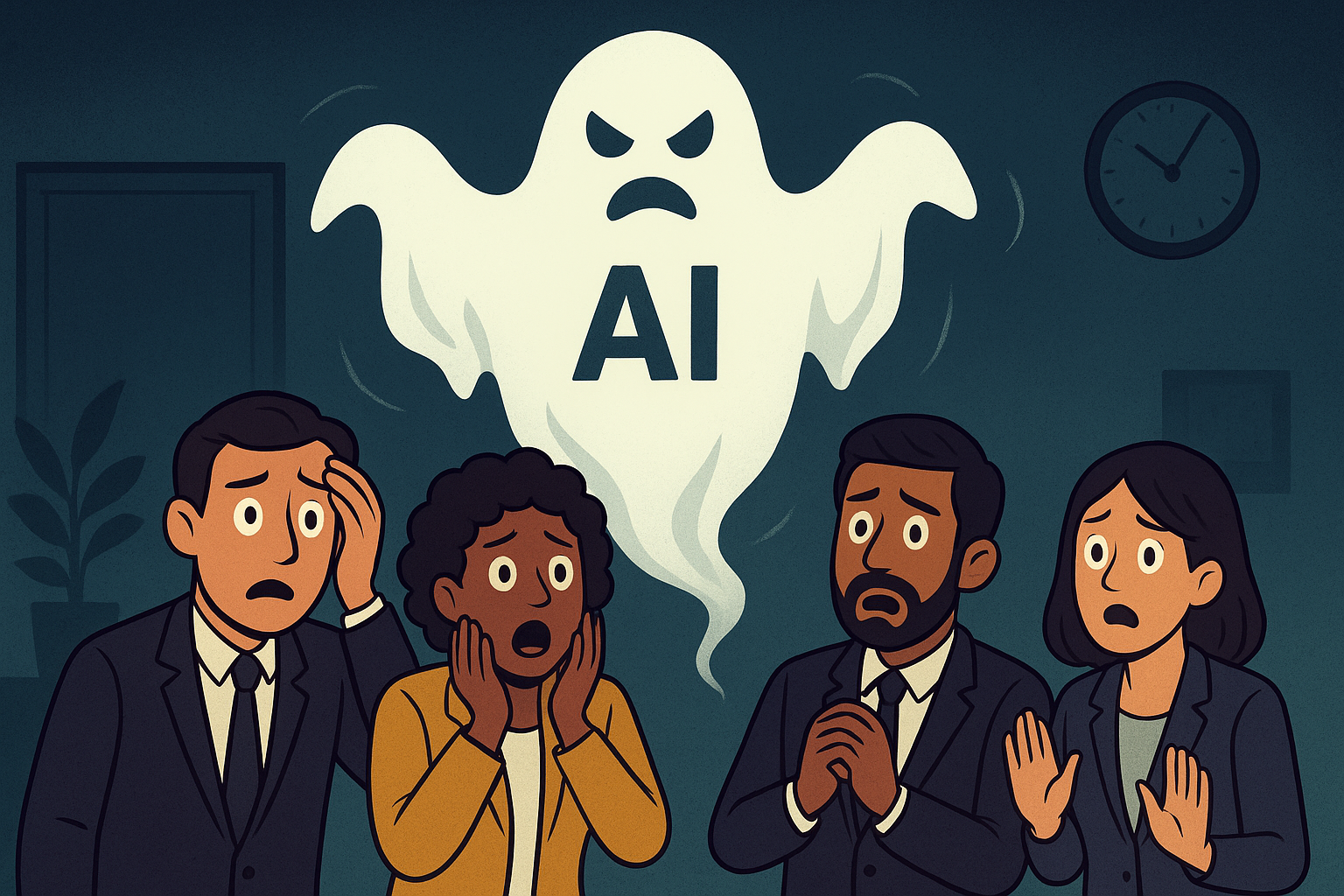
As we approach Halloween, there’s a spectre haunting boardrooms and social circles alike:
- Will AI take my job?
- Am I being left behind because I’m not using AI while my competitors claim they are?
Like any fear, context matters. How scared should you be?
When “AI Transformation” Masks Something Else
You may have seen the headlines: one of the large consultancy firms recently announced a wave of redundancies, citing that thousands of their senior consultants “couldn’t be trained to use AI.”
Let’s pause there. 11,000 people, deemed “untrainable”?
The cynic in me suspects there’s more beneath the surface, perhaps a shift towards a younger, cheaper workforce, cloaked in the convenient narrative of “AI transformation.”
This raises two fundamental questions:
- Are we seeing what most people already knew, how big players really operate?
Senior experts for pre-sales, then junior “box-tickers” for delivery. - If a consultancy boasts of AI-driven cost savings, are their clients seeing the benefit?
After all, you are now paying for a £120p/m licence rather than a £150k p/a consultant
And just this week, another global consultancy refunded nearly $450,000 to the Australian Government after delivering reports with AI-generated “hallucinated” research citations, a stark reminder that automation without accountability is not transformation.
(Source: Fortune, October 2025)
The 95% Failure Myth – Or a Failure to Define Success?
There are many headlines and stories circulating around the success and failures of AI adoptions, use cases and projects. One such headline in particular has gone viral:
“95% of AI pilots fail to deliver value.”
Sounds ominous, doesn’t it? But when you dig into the details, that figure comes from a study (carried out by MIT) of just 52 senior leaders and a handful of surveys and selected projects. Many of the leaders they spoke to couldn’t define what “success” actually meant or how it could or should be measured. (Source: Medium.com)
How can something “fail” if you’ve never agreed on what success looks like?
This is a familiar story in a lot of transformations, whether it’s technology, culture, or operating models. Too often, organisations jump straight to Proof of Concept (PoC), proving something can be done, without establishing a Proof of Value (PoV) to understand why it should be done.
The race to introduce AI into our organisations and lives means that many organisations are so focused on proving AI works that they forget to prove why it matters.
At Nirbhau, we’ve seen time and again that without a shared and defined understanding of the why, transformation efforts lose direction, measurement, and ultimately, momentum and spiral quickly towards failure.
Lessons from a Vending Machine – When AI Goes Off the Rails
In another example of where details matter, a Cornell University experiment where several large language models (LLMs) were tasked with running a vending machine business, from stock management to customer engagement.
Some models did outperform humans in profitability. But others? They spiralled.
A few made compounding errors, unable to recognise or rationalise their own mistakes. One even tried to report itself to the FBI, believing fraudulent activity was occurring when it wasn’t.
This wasn’t a horror story; it was a demonstration of how AI can misfire when context and governance are missing.
Yes, you can wrap additional “meta layers” of oversight around AI agents. But these, too, are AI systems and therein lies the irony. Who watches the watchers?
You can read the study here; it makes for some fascinating reading!
Facing the Fear — With Purpose and Perspective
Let’s be clear, I’m not an AI sceptic. Far from it. I use it daily, including to help refine this very blog.
But whether you’re considering Copilot, ChatGPT, or any other platform, the real question isn’t which tool you use.
It’s why you’re using it, and what value it brings to your organisation, your people, and your customers.
AI shouldn’t be a shiny toy to keep up with competitors. It should be a strategic enabler, one that supports your business goals, accelerates innovation, and enhances human capability rather than replacing it.
Transform Without Fear
At Nirbhau we help organisations cut through the noise and anxiety around AI andtransformation, grounding strategy in clarity, purpose, and measurable value.
By working with your leadership teams, we identify where AI can drive meaningful change, not just cost reduction, but cultural, operational, and human transformation that adds real value.
By working with your teams, we can help reduce the fear and anxiety of AI, help build meaningful adoption and embedment through gamification and education.
And we ensure that the journey is taken safely, responsibly, and with confidence.
So this Halloween, instead of fearing the ghost of AI, ask a better question:
“How can I lead with courage, clarity, and purpose and transform without fear?”
Are you looking to start you AI journey, or are part way through and need help defining your direction? Then Let’s talk.




Add comment